Wanted to Show Through Art Godã¢ââ¢s Creation and the Storied of the Hebrew Bible

Co-ordinate to the Bible, the golden calf (עֵגֶּל הַזָהָב 'ēggel hazāhāv) was an idol (a cult paradigm) made past the Israelites when Moses went up to Mount Sinai. In Hebrew, the incident is known every bit ḥēṭ' ha'ēggel (חֵטְא הַעֵגֶּל) or "the sin of the dogie". It is showtime mentioned in the Volume of Exodus.[1]
Bull worship was common in many cultures. In Egypt, whence co-ordinate to the Exodus narrative the Hebrews had recently come up, the Apis Bull was a comparable object of worship, which some believe the Hebrews were reviving in the wilderness;[2] alternatively, some believe Yahweh, the national god of the Israelites, was associated with or pictured as a calf/bull deity through the process of religious assimilation and syncretism. Amidst the Canaanites, some of whom would become the Israelites,[3] the bull was widely worshipped as the Lunar Bull and equally the beast of El.[4]
Biblical narrative [edit]

When Moses went up into Mount Sinai to receive the 10 Commandments (Exodus 24:12–18), he left the Israelites for forty days and nights. The Israelites feared that he would not return and demanded that Aaron make them "a god to go before them". Aaron gathered upwards the Israelites' golden earrings and ornaments, constructed a "molten calf" and they alleged: "'This is thy god, O Israel, which brought thee upwards out of the country of Arab republic of egypt" (Exodus 32:1–four).
Aaron built an altar earlier the dogie and proclaimed the next solar day to be a feast to the FiftyORD. Then they rose upward early the next day and "offered burnt-offerings, and brought peace-offerings; and the people sat downwardly to eat and to drink, and rose up to play." (Exodus 32:6) God told Moses what the Israelites were up to back in army camp, that they had turned aside quickly out of the way which God allowable them and he was going to destroy them and beginning a new people from Moses. Moses besought and pleaded that they should be spared and "the LORD repented of the evil which He said He would do unto His people." (Exodus 32:xi–14)
Moses went down from the mountain, but upon seeing the dogie, he became angry and threw down the 2 Tablets of Rock, breaking them. Moses burnt the golden dogie in a fire, basis it to powder, scattered information technology on water, and forced the Israelites to drinkable it. When Moses asked him, Aaron admitted to collecting the gold, and throwing information technology into the fire, and said it came out as a calf (Exodus 32:21–24).
Exclusion of the Levites and mass execution [edit]
The Bible records that the tribe of Levi did not worship the gold calf. "Moses stood in the gate of the military camp, and said: 'Whosoever is on the FiftyORD's side, allow him come unto me.' And all the sons of Levi gathered themselves together unto him. And he said unto them: 'Thus saith the LORD, the God of Israel: Put ye every man his sword upon his thigh, and go to and fro from gate to gate throughout the camp, and slay every homo his brother, and every man his companion, and every human his neighbour.' And the sons of Levi did co-ordinate to the word of Moses; and at that place vicious of the people that mean solar day almost 3 yard men."(Exodus 32:26–28)
Other mentions in the Bible [edit]
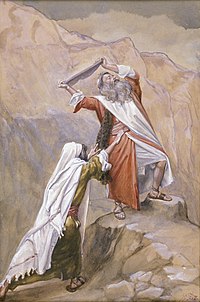
Moses destroying the tables (watercolor circa 1896–1902 past James Tissot)
The gold calf is mentioned in Nehemiah ix:sixteen–21.
"Simply they, our ancestors, became arrogant and stiff-necked, and they did not obey your commands. They refused to listen and failed to retrieve the miracles you lot performed among them. They became strong-necked and in their rebellion appointed a leader in social club to return to their slavery. But y'all are a forgiving God, gracious and compassionate, slow to acrimony and abounding in beloved. Therefore you did not desert them, even when they bandage for themselves an image of a calf and said, 'This is your god, who brought y'all up out of Arab republic of egypt', or when they committed awful blasphemies.
"Because of your great compassion you did not carelessness them in the wilderness. By 24-hour interval the pillar of cloud did not fail to guide them on their path, nor the pillar of fire by night to shine on the way they were to take. You gave your skillful Spirit to instruct them. Y'all did not withhold your manna from their mouths, and yous gave them water for their thirst. For forty years y'all sustained them in the wilderness; they lacked nothing, their clothes did non wear out nor did their feet become bloated."
The language suggests that there are some inconsistencies in the other accounts of the Israelites and their utilize of the calf. As the version in Exodus and 1 Kings are written past Deuteronomistic historians based in the southern Kingdom of Judah, there is a proclivity to expose the Israelites as unfaithful. The inconsistency is primarily located in Exodus 32:4 where "gods" is plural despite the construction of a unmarried dogie.[5]
Jeroboam's golden calves at Bethel and Dan [edit]
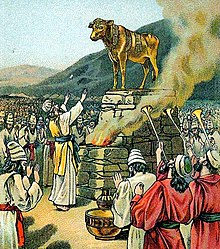
Worshiping the Golden Calf
According to 1 Kings 12:26–30, later on Jeroboam establishes the northern Kingdom of Israel, he contemplates the sacrificial practices of the Israelites.
Jeroboam thought to himself, "The kingdom will at present likely revert to the house of David. If these people go upward to offer sacrifices at the temple of the FiftyORD in Jerusalem, they will once again give their allegiance to their lord, Rehoboam rex of Judah. They will kill me and return to King Rehoboam." Later seeking advice, the male monarch made 2 golden calves. He said to the people, "It is as well much for you to get up to Jerusalem. Here are your gods, Israel, who brought you up out of Egypt." Ane he ready in Bethel, and the other in Dan. And this affair became a sin; the people came to worship the one at Bethel and went as far as Dan to worship the other.
His concern was that the trend to offering sacrifices in Jerusalem, which is in the southern Kingdom of Judah, would lead to a return to King Rehoboam. He makes 2 aureate calves and places them in Bethel and Dan. He erects the two calves in what he figures (in some interpretations) equally substitutes for the cherubim congenital by King Solomon in Jerusalem.[half dozen]
Still, in the Antiquities of the Jews (five. VIII: 8), which is taken from the Septuagint, Josephus states: "He made two golden heifers, and built two lilliputian temples for them, the one in the metropolis Bethel, and the other in Dan...and he put the heifers into both the little temples in the forementioned cities." This is quite incompatible with any resemblance of the "calves" to the Egyptian Apis Bull, just quite indicative of the Egyptian goddess Hathor, to whom in the Egyptian text "Destruction of Mankind" is attributed cataclysmic events similar to those recounted in Exodus.[ citation needed ]
Richard Elliott Friedman says "at a minimum we tin can say that the writer of the gilt calf account in Exodus seems to have taken the words that were traditionally ascribed to Jeroboam and placed them in the mouths of the people." Friedman believes that the story was turned into a polemic, exaggerating the throne platform decoration into idolatry, by a family unit of priests sidelined by Jeroboam.[7]
The declarations of Aaron and Jeroboam are almost identical:
- 'These are your gods, O Israel, who brought y'all upwardly from the land of Egypt' (Exod 32:four, 8);
- 'Behold your gods, O Israel, who brought you up from the land of Egypt (1 Kings 12:28)
Afterward making the golden calf or golden calves both Aaron and Jeroboam gloat festivals. Aaron builds an chantry and Jeroboam ascends an altar (Exod 32:5–6; 1 Kings 12:32–33).[8]
Jewish views [edit]

The Levites killed about 3,000 Israelites who worshipped the Gilt Calf (1984 illustration past Jim Padgett)
In Legends of the Jews, the Bourgeois rabbi and scholar Louis Ginzberg wrote that the worship of the gold calf was the disastrous consequence for Israel who took a mixed multitude in their exodus from Egypt. Had not the mixed multitude joined them, Israel would non have been misled to worship this molten idol. The form of the dogie itself came from a magical virtue of an decoration leafage with the image of the balderdash which is made by Aaron.[ix]
The devotion of State of israel to this worship of the calf was partly explained by a circumstance at passing through the Red Sea, when they beheld the well-nigh singled-out creature about the Celestial Throne which is the resemblance of ox, then they thought information technology was an ox who had helped God in their journey from Arab republic of egypt.[nine] Afterwards seeing Hur son of Miriam who was carelessly murdered past the people post-obit his rebuke of their ingratitude action to God, Aaron was willing rather to accept a sin upon himself to make an idol than to bandage the burden of an evil act upon the people if they commit then terrible sin of killing a priest and prophet among them.[9]
Likewise in that location would exist among the Israelites no priestly caste, and the nation would accept been a nation of priests only if Israel had not sinned through worshiping the golden calf that the greater part of the people lost the right to priesthood, except the tribe of Levi as the but tribe who remained faithful to God and did not partake in this sinful deed.[x]
According to Nachman of Breslov, everyone contributed to the building of the Tabernacle, and the contribution that each Jew fabricated was his or her good points. Thus, the Tabernacle was built past the good points found in each person; this was sufficient to counteract the blemish of the gilded calf.[11] The "good points" are reflected in the "gilt, silver and copper" that the Jews donated. The diverse colors of these metals reverberate the Supernal Colors and the beauty of a person's proficient deeds.[12]
Islamic narrative [edit]
The incident of the worship of the golden calf is narrated in the 2nd chapter of the Quran, named Al-Baqarah, and other Islamic literature. The Quran narrates that after they refused to enter the promised country, God decreed that as punishment the Israelites would wander for forty years. Moses connected to lead the Israelites to Mount Sinai for divine guidance. Co-ordinate to Islamic literature, God ordered Moses to fast for 40 nights before receiving the guidance for the Israelites.[xiii] [xiv] When Moses completed the fasts, he approached God for guidance. During this time, Moses had instructed the Israelites that Aaron was to pb them.[15]
The Israelites grew restless, since Moses had non returned to them, and after thirty days, a man the Quran names Samiri raised doubts amongst the Israelites. Samiri claimed that Moses had forsaken the Israelites and ordered his followers among the Israelites to light a fire and bring him all the jewelry and gold ornaments they had.[xvi] Samiri fashioned the gold into a golden dogie along with the dust on which the affections Gabriel had trodden, which he proclaimed to be the God of Moses and the God who had guided them out of Egypt.[17] There is a sharp contrast betwixt the Quranic and the biblical accounts of the prophet Aaron's actions. The Quran mentions that Aaron attempted to guide and warn the people from worshipping the golden calf. However, the Israelites refused to stop until Moses had returned.[18] The righteous separated themselves from the pagans. God informed Moses that he had tried the Israelites in his absence and that they had failed by worshipping the golden calf.
Returning to the Israelites in great anger, Moses asked Aaron why he had non stopped the Israelites when he had seen them worshipping the golden calf. The Quran reports that Aaron stated that he did non act due to the fright that Moses would blame him for causing divisions amidst the Israelites. Moses realized his helplessness in the state of affairs, and both prayed to God for forgiveness.[19] Co-ordinate to non-Qur'anic sources Moses then questioned Samiri for the creation of the golden calf; Samiri justified his deportment by stating that he had thrown the dust of the basis upon which Gabriel had tread on into the burn down because his soul had suggested it to him.[16] Moses informed him that he would exist banished and that they would burn the aureate dogie and spread its dust into the sea. Moses ordered seventy delegates to repent to God and pray for forgiveness.[20] The delegates traveled alongside Moses to Mount Sinai, where they witnessed the speech between him and God but refused to believe until they had witnessed God with their sight. Every bit punishment, God struck the delegates with lightning and killed them with a violent earthquake.[21] Moses prayed to God for their forgiveness. God forgave and resurrected them and they connected on their journeying.[ citation needed ]
In the Islamic view, the calf-worshipers' sin had been shirk (Arabic: شرك), the sin of idolatry or polytheism. Shirk is the deification or worship of anyone or anything other than Allah, or more literally the institution of "partners" placed beside God, a about serious sin.
Criticism and interpretation [edit]
According to modern scholarship, there are two versions of the Ten Commandments story, in Due east (Exodus xx) and J (Exodus 34), this gives some antiquity and there may exist some original events serving as a footing to the stories. The Gilded Calf story is only in the E version and a afterwards editor added in an explanation that God made a second pair of tablets to give continuity to the J story.[22] The actual Ten Commandments as given in Exodus 20 were also inserted by the redactor who combined the various sources.[23]
Co-ordinate to Michael Coogan, information technology seems that the gold calf was not an idol for another god, and thus a fake god.[24] He cites Exodus 32:iv–5 equally evidence:
He [Aaron] took the golden from them, formed it in a mold, and cast an image of a calf; and they said, "These are your gods, O Israel, who brought you lot up out of the land of Egypt!" When Aaron saw this, he congenital an altar earlier it; and Aaron made annunciation and said, "Tomorrow shall be a festival to the FiftyORD (Yahweh)."
Importantly, there is a single calf in this narrative. While the people refer to it as representative of the "gods", this is a possessive form of the word Elohim (אֱלֹהֶיךָ elo'hecha, from אֱלֹהִים), which is a name of God as well as general give-and-take for "gods". While a reference to singular god does not necessarily imply Yahweh worship, the word usually translated equally 'lord' is Yahweh יהוה in the original, so at least it tin can't be ruled out.[24] In the chronology of Exodus the commandment against the creation of graven images had non yet been given to the people when they pressed upon Aaron to assistance them make the calf, and that such beliefs was not all the same explicitly outlawed.[24]
Some other understanding of the aureate calf narrative is that the dogie was meant to be the pedestal of Yahweh. In Near Eastern art, gods were oft depicted standing on an animal, rather than seated on a throne.[24] This reading suggests that the gilded dogie was merely an alternative to the ark of the covenant or the cherubim upon which Yahweh was enthroned.[24]
The reason for this complication may be understood as
- a criticism of Aaron, as the founder of i priestly house that rivaled the priestly house of Moses, and/or
- as "an attack on the northern kingdom of Israel."[24] The second explanation relies on the "sin of Jeroboam," who was the first male monarch of the northern kingdom, equally the cause of the northern kingdom's fall to Assyria in 722 BCE.[24] Jeroboam'south "sin" was creating two calves of gilt, and sending one to Bethel every bit a worship site in the s of the Kingdom, and the other to Dan as a worship site in the north, so that the people of the northern kingdom would not have to continue to go to Jerusalem to worship (see one Kings 12:26–30). According to Coogan, this episode is part of the Deuteronomistic history, written in the southern Kingdom of Judah, after the fall of the northern kingdom, which was biased against the northern kingdom.[24] Coogan maintains that Jeroboam was simply presenting an culling to the cherubim of the Temple in Jerusalem, and that calves did not bespeak non-Yahwehistic worship.[24]
The documentary hypothesis can exist used to further understand the layers of this narrative: it is plausible that the earliest story of the golden calf was preserved by E (State of israel source) and originated in the Northern kingdom. When Eastward and J (Judah source) were combined after the fall of northern kingdom, "the narrative was reworked to portray the northern kingdom in a negative light," and the worship of the calf was depicted as "polytheism, with the suggestion of a sexual orgy" (see Exodus 32:6). When compiling the narratives, P (a afterwards Priest source from Jerusalem) may have minimized Aaron'southward guilt in the thing, only preserved the negativity associated with the dogie.[24]
Alternatively information technology could exist said that there is no golden calf story in the J source, and if information technology is correct that the Jeroboam story was the original as stated by Friedman, then it is unlikely that the golden calf events as described in Exodus occurred at all. Friedman states that the smashing of the Ten Commandments by Moses when he beheld the worship of the gilded calf, is really an try to cast into doubtfulness the validity of Judah'due south central shrine, the Ark of the Covenant. "The author of E, in fashioning the golden calf story, attacked both the Israelite and Judean religious establishments."[25]
As admiration of wealth [edit]
A metaphoric estimation emphasizes the "gold" part of "golden calf" to criticize the pursuit of wealth.[26] This usage tin be found in Spanish[27] where Mammon, the Gospel personification of idolatry of wealth, is not so current.
In pop civilization [edit]
Eponymous subjects [edit]
- Le veau d'or est toujours debout (The Golden Dogie is all the same standing), an aria in Charles Gounod's opera Faust
- Cave of the Aureate Calf, a notorious nightclub in Edwardian London, created by Frida Uhl
- "The Golden Dogie and the Altar", an episode in the unfinished opera Moses und Aron, a three-human activity, uncompleted opera by Arnold Schoenberg
- The Aureate Calf, a sculpture past conceptual artist Damien Hirst
- "The Golden Calf", a song on the Prefab Sprout album From Langley Park to Memphis
- Mooby the Golden Dogie, a fictional character featured in the works of Kevin Smith
- The Little Gold Dogie, a satirical novel by Soviet authors Ilf and Petrov
- Dance Around the Aureate Calf, a painting by Emil Nolde
- The Dogie of Dan, a sculpture by James Due west. Washington Jr.
- The 2021 Conservative Political Action Briefing (CPAC) featured a gilt statue of former United States President Donald Trump. Online commentators compared the figure with the Exodus'south aureate calf, considering Trump's largely evangelical and conservative Christian base.[28] [29] [thirty] [31]
Others [edit]
- In Episode 79 of Batman, a Aureate Calf full of money was stolen by The Riddler[32]
See besides [edit]
- Balderdash of Heaven
- Cattle in faith
- Erev Rav
- Gugalanna
- Ki Tissa and Eikev, Torah parshiot dealing with the Golden Dogie
- Red heifer
- Sacred bull
- Tauroctony
Further reading [edit]
- Driscoll, James F. (1909). . In Herbermann, Charles (ed.). Cosmic Encyclopedia. Vol. half-dozen. New York: Robert Appleton Company.
- Friedrich Justus Knecht (1910). . A Practical Commentary on Holy Scripture. B. Herder.
Notes [edit]
- ^ (Exodus 32:4
- ^ The early Christian Apostolic Constitutions, vi. 4 (c. 380), mentions that "the law is the decalogue, which the Lord promulgated to them with an audible voice, earlier the people made that dogie which represented the Egyptian Apis."
- ^ Finklestein, Israel; Silberman, Neil Asher (2002). The Bible Unearthed. Touchstone. p. 118. ISBN0-684-86913-vi.
Virtually of the people who formed early on Israel were local people — the same people whom we see in the highlands throughout the Bronze and Iron Ages. The early Israelites were — irony of ironies — themselves originally Canaanites!
- ^ Friedman, Richard Elliott (2019) [First published 1987]. Who Wrote the Bible?. Simon & Schuster. ISBN978-1-9821-2900-two.
The dogie, or immature bull, was ofttimes associated with the god El, the chief god of the Canaanites, who was in fact referred to equally "Bull El.".
- ^ Coogan, 2009, pg. 116–117.
- ^ Coogan, pg. 117, 2009
- ^ Friedman, Richard Elliott "Who Wrote the Bible?" 1987 pp 72–3
- ^ Harvey, John Due east. (2004). Retelling the Torah: the Deuteronomistic historian's use of Tetrateuchal Narratives . New York; London: T & T Clark International. p. ii. OCLC 276852204. : "The subsequent declarations of Aaron'south people and Jeroboam are virtually identical: 'These are your gods, O Israel, who brought you up from the land of Egypt' (Exod 32:4, 8); 'Behold your gods, O Israel, who brought you lot upwardly from the state ..."
- ^ a b c Ginzberg, Louis (1909). The Legends of the Jews Book III : The Aureate Calf (Translated past Henrietta Szold) Philadelphia: Jewish Publication Guild
- ^ Ginzberg, Louis (1909) The Legends of the Jews Volume 3 : The Revelations in the Tabernacle (Translated by Henrietta Szold) Philadelphia: Jewish Publication Society
- ^ Likutey Halakhot I
- ^ Rebbe Nachman of Breslov. Exodus-Leviticus Jerusalem/New York, Breslov Inquiry Institute
- ^ (Quran 2:51)
- ^ (Quran 7:142)
- ^ (Quran 7:142)
- ^ a b Thou. Th Houtsma (1993). First encyclopaedia of Islam: 1913-1936. p. 136. ISBN9004097961.
- ^ Abdul-Sahib Al-Hasani Al-'amili. The Prophets, Their Lives and Their Stories. p. 354. ISBN9781605067063.
- ^ IslamKotob, Sayyed Abul Hasan Ali Nadwi. Stories of the Prophets - قصص الانبياء. p. 115.
- ^ (Quran 7:167-174)
- ^ IslamKotob, Sayyed Abul Hasan Ali Nadwi. Stories of the Prophets - قصص الانبياء. p. 113.
- ^ Iftikhar Ahmed Mehar (2003). Al-Islam: Inception to Determination. p. 123. ISBN9781410732729.
- ^ Friedman, Richard Elliott. 2003. The Bible with Sources Revealed, p 177.
- ^ Friedman, Richard Elliott. 2003. The Bible with Sources Revealed, p 153.
- ^ a b c d eastward f g h i j Coogan, Yard. (2009). A Cursory Introduction to the Erstwhile Testament: The Hebrew Bible in its context. Oxford: Oxford University Press. p. 115.
- ^ Friedman, Richard Elliott (1987). Who Wrote the Bible?. p. 74.
- ^ Squires, Nick (2013-05-17). "Pope blames tyranny of capitalism for making people miserable". The Age . Retrieved 2019-09-25 .
- ^ "becerro de oro". Diccionario de la Real Academia Española.
- ^ Trump's golden statue compared to Gilded Calf in online derision The Jerusalem Post
- ^ Castronuovo, Celine. "Golden statue of Trump at CPAC ridiculed online". thehill.com. The Hill. Retrieved 28 Feb 2021.
- ^ Beauchamp, Zach. "This aureate statue of Trump at CPAC is a perfect metaphor for the country of the GOP". Voice.com. Vocalization. Retrieved 28 Feb 2021.
- ^ Chait, Jonathan. "Donald Trump, CPAC and Republican Cult of Losing". nymag.com . Retrieved 28 February 2021.
- ^ DeCandido, Keith (September xvi, 2016). "Holy Rewatch Batman! "Batman'due south Anniversary" / "A Riddling Controversy"". Tor.com. Macmillan Publishers. Archived from the original on September 17, 2016.
External links [edit]
- The Golden dogie from a Jewish perspective at Chabad.org
- Rabbi Fohrman's Lectures on the Gilt Calf
- The Gilt calf from Ein Hod perspective
- Islamic estimation of the story of the Golden calf in the Qur'an
- Story of Muses and Aaron in the Qur'an
- Jewish Encyclopedia: Calf, Golden
- Online Quran Project 20.83
delargiehatestaked.blogspot.com
Source: https://en.wikipedia.org/wiki/Golden_calf
0 Response to "Wanted to Show Through Art Godã¢ââ¢s Creation and the Storied of the Hebrew Bible"
Post a Comment