What Are Arctic Fox Babies Called When Do the Arctic Fox Animal Usually Mate
This mail may incorporate affiliate links to our partners similar Chewy, Amazon, and others. Purchasing through these helps us further the A-Z Animals mission to brainwash about the world's species..
"Arctic Foxes Are Republic of iceland's Only Native Mammal"
Arctic foxes (often misspelled equally artic fox or artic foxes) are small, adorable animals and have natural adaptations protecting them from predators and frigid temperatures. According to fossils, Arctic foxes got their starting time in Tibet during the Pliocene Epoch, 2.6 one thousand thousand years ago, then spread to North America and Eurasia by migrating over ice-land bridges. The species is Iceland's just native mammal, and while hundreds of thousands currently roam around the Arctic Circle, climate alter threatens to decimate populations in the coming years.
Incredible Arctic Fox Facts!
- They are couch dwellers that occupy elaborate dens, some of which are centuries old!
- The species diverged from domesticated dogs 12 meg years ago.
- Arctic foxes are the master carriers of the Chill rabies virus.
- Individuals of the species can trek up to 96.3 miles (155 kilometers) in a single day!
- These foxes are smart, curious, and fast! When fugitive predators and hunting casualty, they can sprint up to l kilometers per hour.
Chill Flim-flam Scientific Proper noun
The scientific name for these foxes is Vulpes lagopus — which has Ancient Greek and Latin roots. "Vulpes" is the Latin give-and-take for "play a joke on," and lagopus comes from ii Aboriginal Greek words, lagōs, which means "hare," and pous, which means "human foot." Together the scientific name translates to "hairy-footed fox."
In 1758, the father of taxonomy, Carl Linneaus, assigned the species two names: Alopex lagopus and Canis lagopus. Since then, scientists have gathered more than genetic information and changed it to Vulpes lagopus.
Arctic foxes are also known as white foxes, polar foxes, and snowfall foxes. Adult males are called "dogs" and females "vixens." A group of these foxes is known as either a "skulk" or "leash."
Tiriganiarjuk is the Inuit word for Arctic play a joke on, which translates to "the lilliputian white one." In other native languages, the species' name translates to "the one who walks a lot."
Arctic Fox Appearance and Behavior
Chill Fox Advent
The male person foxes are slightly larger than females of the species. Big individuals are about the size of Jack Russell terriers; smaller ones are the size of chihuahuas.
| Gender | Average Size | Boilerplate Height | Average Weight |
|---|---|---|---|
| Female | 20 inches (52 centimeters) | ix.8 to 11.viii inches (25 to 30 centimeters) | 3.1 to seven.1 pounds (1.4 to 3.2 kilograms) |
| Male | 22 inches (55 centimeters) | nine.8 to 11.8 inches (25 to 30 centimeters) | 7.1 to 20.7 pounds (3.ii to 9.four kilograms) |
Adaptations That Keep Chill Foxes Warm
Chill foxes are animals that present in two color morphs: white and bluish. Ninety-nine percentage have the white color morph, significant their fur is white in winter to blend in with the ice and brown in summer to camouflage with cliffs and rocks. The other one percent — mainly in coastal regions — has the blueish morph, pregnant they have rock blue-ice coloring in the wintertime and gray-blue in the summer. These color adaptations help them blend into the surroundings and evade predators.
Both male and female play a joke on tails — aka "brushes" — measure nigh 12 inches (30 centimeters). More than than just a residuum aid, they also serve equally blankets. It's one of several adaptations that allow them to survive sub-zero winters. In improver to their long and warm tails, Arctic foxes also have fur-covered paws that work to keep their bodies toasty warm in the winter.
Thick ears, short muzzles, and multilayer pelage also help Arctic foxes survive freezing environments. Their fur is the warmest of any mammal, and their compact bodies optimally conserve heat. Amend yet, they can separately control their hand and core temperatures — which makes for comfy ice walks!
Ideally engineered to withstand harsh climates, they don't offset shivering until the mercury reaches -94 °F (-70 °C). Learn well-nigh the toughest animals in the world here.
Arctic Fox Behavior
Arctic foxes are animals that can be active round the clock. During the autumn and wintertime, they lead more alone lives and reduce activity to preserve insular fat — but they don't hibernate. In the spring and summer, these foxes convene to live as families, breed, and heighten pups.
When not out hunting, foraging, or teaching pups survival tactics, arctic foxes hang out in gigantic, maze-like dens that typically face southward to all-time harness the sun's heat. In warm weather, they slumber outside; during the harsh winters, they slumber within.
Arctic fox dens are constructed for maximum predator evasion and pup protection. Some are then complex that they have more than than 100 entrances! Appreciative of their ancestors' burrowing efforts, the foxes preserve dens instead of building new complexes every year. In fact, some are hundreds of years former!
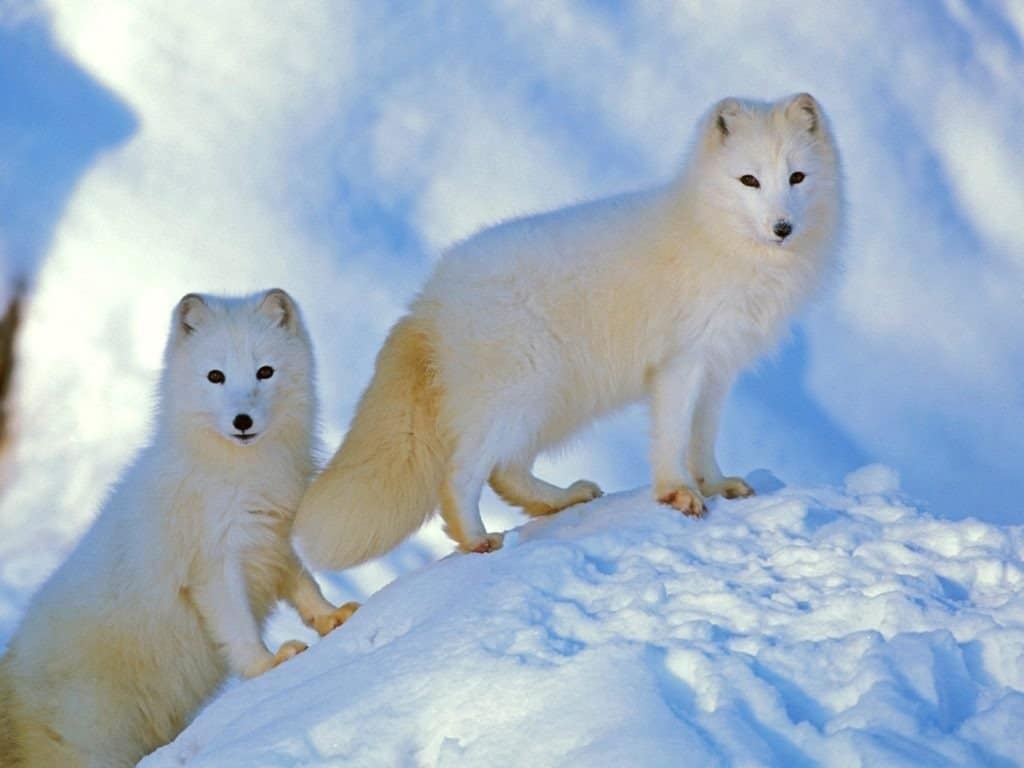
 rokopix/Shutterstock.com
Arctic Fox Habitat
Where tin y'all notice Arctic foxes? The species populates the Northern Hemisphere's Arctic Circumvolve where summer temperatures range betwixt 14 and 86 °F (-x and thirty °C), and the winter thermometer hovers around -30° F (-34°C).
Communities are scattered throughout the treeless tundra regions of Northward America, Asia, Europe, Greenland, and Iceland, with about populations living in pack-ice areas. However, some Canadian Chill foxes inhabit boreal forests filled with pines and spruces.
To date, scientists have identified four subspecies.
| Subspecies Location | Arctic Fox Subspecies Scientific Proper name |
|---|---|
| Bering Islands Arctic pull a fast one on | V.I. beringensis |
| Greenland Arctic fob | V.I. foragoapusis |
| Republic of iceland Arctic fox | V.I. fuliginosus |
| Pribilof Islands Arctic fob | V.I. pribilofensis |
Arctic Fox Diet: Prey
What exercise Arctic foxes eat? Their meals of option are lemmings, voles, hares, and other small rodents. When their preferred meat is unavailable, Arctic foxes chow downwardly on fish, snow geese eggs, ptarmigan, bickering, puffins, ringed seal pups, and reindeer. When things are truly scarce, they turn to berries and seaweed.
And yes, when faced with starvation, they eat their own carrion!
During the summertime and autumn, aided by their sharp smell and sight senses, they hunt prey. They can sniff out seal lairs from over a mile away and hear lemmings burrowing several inches below ground. On a good day, a family unit of foxes can down dozens of rodents. When lucky enough to take a surplus of food, the foxes bury it for a rainy twenty-four hours.
Only life gets a lot tougher in the winter. Meat is much harder to observe, and vegetation is dormant. To survive, these foxes stem polar bears and dine on their scraps. Just information technology's a dangerous endeavor considering polar bears prey on foxes!
Arctic Fox Predators and Threats
What animals casualty on Arctic foxes? The species' main predators are polar bears, wolves, wolverines, brown bears, crimson foxes, and humans. They also must keep an eye out for fast gilded eagles, bald eagles, and snowy owls that dive down and snatch infant foxes.
But these days, natural predators aren't their worst threat — climate change and offshore drilling are fast condign the species' main nemesis. Arctic temperatures are skyrocketing — which leads to reduced sea water ice and ascension sea levels. Add some destructive oil extraction off the coast, and information technology'due south an ecological tinderbox on the brink of explosion.
Plus, even though the foxes are still plentiful in most regions, other animals are dying off and creating food shortages. Moreover, due to speedily melting water ice, their lighter coats are becoming a liability, not an advantage. To complete the perfect tempest, increasingly, these foxes are losing ground to the larger red fox.
Native Arctic peoples nevertheless retain the right to chase polar foxes for sustenance, but commercial hunting of the species is now off-limits.
Chill Fox Reproduction, Babies, and Lifespan
Arctic Fox Reproduction
When the snow melts and the sunday comes out of hibernation, these foxes gather for the mating season between belatedly February and May. In food-insecure populations, these foxes course monogamous pairs for the season. In communities where nutrient is arable, they're more than promiscuous and form circuitous social structures where multiple individuals look afterward each others' newborns.
Typically, inland populations are more monogamous than littoral ones — the exception is Icelandic Arctic foxes. The subspecies exhibits strong familial ties, and offspring will often stick effectually their parents' territories for a long time, even in times of famine when nutrient can be found elsewhere.
Females gestate for about 52 days and give birth betwixt Apr and July to litters ranging betwixt v and 25, the most of all carnivore species.
Arctic Play tricks Babies
Baby Chill foxes are chosen "kits." They're born with nighttime fur and bask the care and attention of both parents. Kits nurse for about 45 days and begin to emerge from the den later on three weeks. By calendar week nine, the pups are usually set to make information technology on their ain. At 9 months, they're sexually mature and ready to start mating.
Chill Play tricks Lifespan
Arctic foxes don't live long. Though fast, in the wild nearly become behave prey between iii and half dozen years old. Only even in captivity, they usually only arrive to ten or 11.
Arctic Fox Population
Currently, several hundred thousand these foxes alive in the wild, and the International Marriage for the Conservation of Nature categorizes the species under To the lowest degree Business concern on its Ruby List. But that doesn't tell the whole story.
Climatic change is speedily damaging Arctic play tricks habitats, and if things don't modify over the next decade, the species could get a global warming casualty.
Already, the Scandinavian population is Endangered. Less than 200 individuals remain, and astringent inbreeding farther threatens its survival. Conservationists are in the process of introducing new individuals of breeding age into the area, simply volition their efforts work? It remains to be seen.
Arctic Foxes In U.s.' Zoos
Below is a fractional list of U.S. zoos with these foxes.
Detroit Zoo: Moxie and Alex, two females, live in the Detroit Zoo's state-of-the-fine art Arctic Band of Life habitat.
San Diego Zoo: Despite being in sunny California, the San Diego Zoo is home to 2 of these foxes named Isiq and Kaniq that live in the Polar Bear Plunge enclosure.
Stone Zoo: Stone Zoo, in Stoneham, Massachusetts, cares for two fast Arctic foxes that beloved to whiz around their enclosure.
Signal Defiance Zoo: Point Defiance Zoo and Aquarium in Tacoma, Washington maintains a big exhibit for ii of them.
North Carolina Zoo: The Rocky Coast showroom at the North Carolina Zoo is home to two of the foxes.
Other stateside zoos with these foxes include:
- Cincinnati Zoo and Botanical Garden in Ohio
- Potter Park Zoo in Michigan
- Buffalo Zoo in New York
- Columbus Zoo in Ohio
- Tulsa Zoo in Oklahoma
- Wildwood Zoo in Wisconsin
- Racine Zoo in Wisconsin
- Austin Zoo in Texas
View all 105 animals that outset with A
Chill foxes are omnivores, meaning they eat both meat and plants.
Chill foxes are pocket-size and fast — but non a massive threat to humans. However, always be cautious around wild animals and keep your distance if not trained to interact with them.
Arctic foxes prey on lemmings, voles, hares, fish, snow geese eggs, ptarmigan, bickering, puffins, ringed seal pups, reindeer, berries, and seaweed. In times of extreme dearth, Arctic foxes volition even swallow their own carrion!
Pocket-size Arctic foxes are nigh half the size of a schoolhouse ruler; larger ones are well-nigh the size of two and a half new pencils.
Hundreds of thousands of Arctic foxes currently roam the Earth. But due to climatic change and reckless oil drilling, their numbers are declining. Populations in Norway, Sweden, and Finland are already Endangered.
Chill Foxes vest to the Kingdom Animalia.
Chill Foxes belong to the phylum Chordata.
Arctic Foxes belong to the class Mammalia.
Chill Foxes vest to the family Canidae.
Arctic Foxes vest to the order Carnivora.
Arctic Foxes belong to the genus Vulpes.
Chill Foxes are covered in Fur.
Chill Foxes have thick fur that changes color with the seasons.
The average litter size for an Chill Play a joke on is 5.
The scientific name for the Chill Fob is Vulpes lagopus.
Chill Foxes can live for 7 to ten years.
A baby Arctic Fox is called a kit.
An Arctic Pull a fast one on can travel at speeds of upward to thirty miles per hour.
delargiehatestaked.blogspot.com
Source: https://a-z-animals.com/animals/arctic-fox/
0 Response to "What Are Arctic Fox Babies Called When Do the Arctic Fox Animal Usually Mate"
Post a Comment